
3 Steps to Create SEO-Friendly Content
Article Summary Points
- Treat keyword research as evidence, not the goalpost.
- Get curious about the human behind the search.
- Do it better than page one by answering questions immediately, showing your work, and taking a position.
- Clean up your existing content.
- Give before you get.
Category: Content Strategy, Guide | Tags:



Ranking is downstream of being useful to a person. That’s the whole Avalanche content philosophy in a nutshell. Let’s get into it.
In This Guide
What Is SEO-Friendly Content?
SEO-friendly content answers a search query well enough that a search engine has no better option to show. It starts with keyword research as evidence of what people want, adds curiosity about why they want it, and ends with execution good enough that the searcher doesn’t look for another source.
Notice that that definition doesn’t mention plugins, word counts, or keyword density percentages. Instead, it contains a person.
Google Is Already Telling You
Search “how to write SEO content” right now and watch how Google structures the results.
At the top, you’ll find an AI Overview, sponsored results (cough ads cough), Google’s own documentation, and polished guides from tools like Ahrefs and Semrush. But scroll a scooch further, and you’ll see where Google carves out the “What people are saying” and “Discussion and forums” sections. Both are packed with regular people talking to each other. LinkedIn posts and Reddit threads, some of them three and four years old, are still hanging around.
Google didn’t build those sections as a favor to Reddit but because that’s where people say the unfiltered things that would never make it into a listicle. That personal experience is the good stuff. Google knows it, you and I know it, and so that content gets top billing on a page about how to write. (And I’d be willing to bet you would trust a Reddit thread first.)
So now that we know the lesson, how do we apply it? We can do that with (pretend I’m doing a Billy Mays impression) three easy steps!
Step 1: Treat Keyword Research as Evidence
Every keyword tool hands you a search volume number. But that number is a national monthly average, not a goal unto itself.
Twelve hundred searches a month for “paver patio cost” mean twelve hundred people across the entire United States want to know what a paver patio costs and can’t find out without asking a machine. The numbers might look different based on your locality, but those search volumes and keyword difficulties are highway markers telling you you’re on the right path.
Let’s look at “landscaping grand rapids.”
- Volume: 260
- Keyword difficulty: 38% (“possible”)
- What it tells you about your customers: The search intent is “commercial,” but other than that… zip.
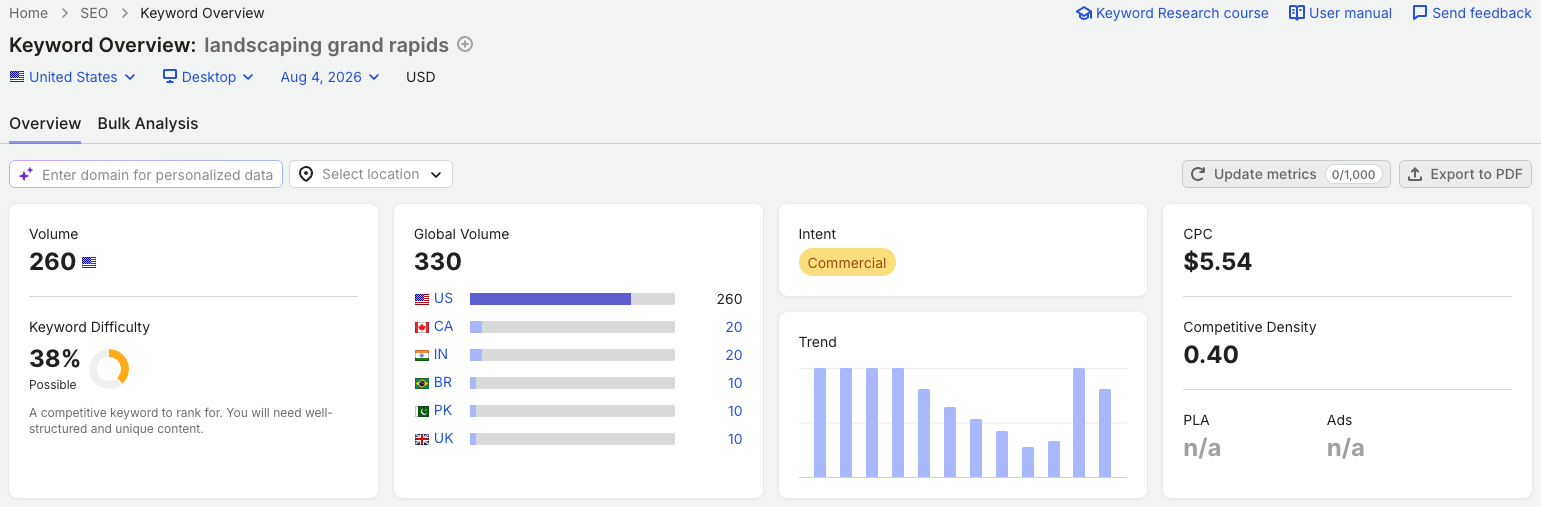
Somebody searching that keyword might want a full redesign, a weekly mow, or a job. (Or maybe they want to know about the landscaping the city has done, who can say?) It’s a good keyword, but not the best one.
Compare that to “how much does a paver patio cost in michigan.” Semrush tells you nobody searches for that, but the SERPs say otherwise. The top 9 results, according to Semrush, are Facebook and Reddit threads (people talking to each other!) and local landscapers publishing informational price guides on their websites.
With a keyword like “how much does a paver patio cost in michigan,” you know who that person is, what they’re deciding, and what they’ll want to know thirty seconds from now. Medium-tail and long-tail terms outperform because they come with a person attached.
Start your keyword research the usual way. Pull volume, filter for questions, check what you can plausibly rank for. Then sort what’s left by asking “How much can I tell about the human who typed this?”
Step 2: Get Curious About the Human
Most content answers the query and stops. That’s why AI Overviews so easily yoinked a massive amount of traffic from underwhelming pages.
A query is the tip of something. Underneath it is a person with a budget, a deadline, a skeptical spouse, or a bad experience with a contractor who ghosted them. They didn’t wake up wanting to read about paver patios but wanting a backyard they’re not embarrassed by before their daughter’s graduation party in June.
So get greedy about everything else they might need. What made them search today instead of last March? What do they have to decide before they can hire anyone? What will they Google thirty seconds from now? What are they afraid of? What would make them trust a stranger with their money?
You don’t have to invent these answers. They’re already out there in these five spots:
- People Also Ask and related searches, which are Google telling you what the next question is.
- Reddit, Facebook groups, and forums, where people describe a problem before a salesperson trains them out of it.
- Reviews. Yours, your competitors’, and especially the three-star ones, where people explain what went wrong and what was just okay.
- Your inbox. Sales calls are transcripts of your audience saying out loud what confuses them.
- Whoever answers your phone. That person has fielded the same six questions four thousand times.
Write down what you find. That list, not the keyword, is your outline. We keep ours in a content template so the thinking happens before the writing does.
Step 3: Do It Better Than Page One
Open the top ten results. Read the AI Overview. Read the People Also Ask answers. Then ask “How could I do this better?” (Pro tip: Better doesn’t automatically mean longer.)
Answer the Question Immediately
This tip comes from journalism, otherwise known as “don’t bury the lede.” Put the answer in the first two sentences under the header in plain language. Then, use the inverted pyramid structure to expound on it.
Search engines and AI tools look for those first sentences to form their snippets and AI Overviews, and humans decide at a glance whether they want to keep reading. Give them the answer they came for; don’t incite frustration by forcing them to scroll for a one-sentence answer.
Show Your Work
When you’re selling a product or service, people (and search engines) want proof:
- Photos of jobs you did
- Numbers from projects you ran
- Screenshots of the things you’re describing
Google values expertise when it’s evaluating whether content is valuable to its users. Anything you can do to show that, yes, you did do that work and, yes, you do know what you’re talking about is SEO gold.
Take a Position
A lot of ranking content, especially the stuff written by AI, refuses to say anything concrete or anything that could be wrong. There’s a lot of hedging and maybes. So just say the thing. Have an opinion. If you’re a landscaper and you know that weed barrier fabric sucks, don’t recommend it as an option in a blog about weed control methods. The internet has too many “balanced,” milquetoast takes as it is.
Cut the Throat-Clearing
People will read long-form content. They just don’t want to read long-winded content.
Use Headers a Person Would Search
“How Much Does a Paver Patio Cost?” beats “Cost Considerations.” You’ll pick up an extra long-tail keyword and give that section the clarity it deserves.
An SEO-Friendly Writing Example
Here’s a paragraph from a landscaping company’s page about paver patios. It’s grammatically perfect, on brand, and ranks nowhere.
“Paver patios are a great addition to any home. They offer durability, beauty, and increased property value. Our team has years of experience installing paver patios for homeowners throughout West Michigan. Contact us today to learn more about our paver patio services!”
Are you bored? I’m bored. Let’s run it through the steps we just covered.
- Step 1: The keyword is “paver patio costs,” which means someone is trying to find a hard number to budget by.
- Step 2: The person behind that query is nervous about the price tag and wants to know why Angi says one thing and the last contractor they called said something else.
- Step 3: Page 1 is overloaded with paragraphs like that, which are technically perfect but don’t say anything about price.
Here’s the rewrite:
“A paver patio in West Michigan costs $18 to $30 per square foot installed, so a typical 300-square-foot patio costs between $5,400 and $9,000. Base depth, paver type, and regrading influence the price. A quote lower than $18 to $30 can indicate cut corners.”
That paragraph is written for a human. It answers the question, answers the “Why does the range vary so much?” objection, and makes a statement based on experience. This paragraph not only is helpful to a human but also has a solid chance of making it into an AI Overview.
Does AI-Generated Content Hurt Your SEO?
Google’s stated position is that it doesn’t care how content gets produced, only whether it helps somebody. At face value, that’s great, but the unfortunate truth is that most AI content doesn’t help anybody. In my experience, it’s like throwing page one into a blender. You get the average of what already ranks, but nothing new.
At Avalanche, we recommend using AI for the work that doesn’t require personal experience.
- Sorting a messy keyword list into topics
- Drafting an outline once you’ve decided what the page should say
- Cutting a paragraph you already wrote down to half its length
- Finding the questions you forgot to answer
AI can’t create the details that make a page valuable, such as:
- Knowing that a quote under $8 a square foot (or whatever) means that the contractor skipped something.
- Knowing which question the customer asks on the phone but never types into Google.
- Holding an opinion that could turn out to be wrong.
- Having been standing there in October when it went pear-shaped.
If you’re publishing the same thing as everyone else, your website will drown in the sea of sameness. Publishing what your team learned is a life raft.
How to Clean Up Existing Content
Stop Competing With Yourself
Duplicate content happens when two URLs on your site say roughly the same thing. Google has to pick one to rank, and the authority both pages earned gets split between them. Pick the stronger page, 301 redirect the weaker one into it, or add a canonical tag pointing at the version you want to keep.
This post is a live example. Avalanche had two pages saying similar things about writing SEO content. One had been live for six years and ranked for a grand total of zero keywords. (See, even the people who do this for a living goof up sometimes.) Now there’s one page, and the old URL points here.
Link Out to Sources You Trust
“Cite your sources” didn’t end with high school research papers. Whenever you cite a number, a fact, or anything else that’s not original to you, link to whoever produced it. It helps search engines see how your page fits into everything else on the topic, and it helps readers trust that you aren’t making things up.
Update It
Publishing is the start, not the finish. Every six to twelve months, pull the page in Semrush, find the terms where it ranks on page two, and rewrite so those people get what they came for. While you’re in there, fix any dead links or outdated statistics. Then, use Page Pulse to keep tabs on how your edits impact your KPIs.
Give Before You Get
Caring about the human is what makes a website SEO-friendly. No plugin or word count can replace that. It requires you to prioritize offering helpful information or a unique experience that stands out in the Sea of Sameness. Here are some examples from our own clients:
- Publicly publishing pricing information without worrying about whether competitors will see it.
- Showing off all their work, even if the photos aren’t magazine-grade.
- Offering a free download or guide.
- Writing DIY-focused blogs to help readers decide whether hiring a pro is right for them. (And I mean truly right for them, not just steering them toward a form fill.)
- Showcasing real feedback and results, not simply curated reviews.
Unfortunately, many businesses want quick results. They want AI to pump out a bunch of blogs and get them ranking yesterday. But genuine growth – sustainable growth, even – comes from giving.
And that’s why I just handed you the Avalanche content writing playbook.
Prefer for Someone Else to Do the Writing?
Hey, I had to offer! 🙂 Avalanche writes content for businesses that live and die by Google. Schedule an intro call and talk to Keelie or Lance about getting started with us. There’s a 50/50 shot that I (Stephanie) will be your dedicated writer once you sign on!
Frequently Asked Questions
What is SEO-friendly content?
SEO-friendly content answers a search query well enough that a search engine has no better option to show. It begins with keyword research as evidence of what people want, adds curiosity about why they want it, and ends with execution good enough that the searcher stops looking.
Why is duplicate content a problem for SEO?
When two URLs on your site say roughly the same thing, Google has to choose which one to rank, and the authority both pages earned gets split between them. Neither one wins. Fix it by 301 redirecting the weaker page into the stronger one, or by adding a canonical tag.
Does AI-generated content hurt your SEO?
Google evaluates whether content helps somebody, not how it was produced. The catch is that most AI content summarizes what already ranks, which makes it a slightly worse copy of page one. Use AI for outlines and trimming, and write the parts that come from having done the work.
Can ChatGPT write SEO content?
Sure, and it’ll hand you something grammatical and generic in about four seconds. The trouble isn’t quality, it’s sameness. ChatGPT writes the average of what already ranks, and the average never outranks anything. Let it draft and trim. Write the parts that come from having done the work yourself.
How long should SEO content be?
Long enough to answer the question and short enough that nobody bounces. Word count isn’t a ranking factor. Match the depth of whatever already ranks, then cut every sentence that exists to hit a number. Six hundred words that answer the question beat two thousand that circle it.
How many keywords should one page target?
One primary term, plus the variations and questions that share its intent. If two keywords need two different answers, they need two different pages. If they need the same answer, splitting them across two pages creates the duplicate content problem above.
How long does SEO content take to rank?
Usually three to six months for a new page on an established site, and longer on a young domain or a competitive term. The pages that rank inside a month are almost always the ones answering a question nobody else had bothered to answer well.
What is the difference between SEO content and copywriting?
Content informs. Copy persuades. SEO content brings a stranger to your website by answering the question they typed into Google. Copy converts them once they arrive. Most pages need both, and most pages pick one, then wonder why the traffic never turns into phone calls.
How often should you update SEO content?
Every six to twelve months. Pull the page in Semrush, find the terms where it ranks on page two, and rewrite so those searchers get what they came for. Fix dead links, replace aging statistics, and republish. Updating an existing page usually beats writing a new one.
Share this article:
The Avalanche Email: Fun. Simple. Educational. No Selling.
Learn Result-focused SEO & Content
Join over 2,272+ others who get one email every Wednesday with simple instructions on how to get more website traffic and leads through SEO and content marketing. (Learn more about the email)



Keep Learning
3 Steps to Create SEO-Friendly Content
SEO content ranks when it serves the person who typed the query. Get the three steps, a live rewrite, and a straight answer on AI-generated content.
Volunteering at Kids’ Food Basket – ’26 Retreat
See how the Avalanche Creative team gave back at Kids’ Food Basket, packing burritos for families across West Michigan during our retreat.
Saving the Galaxy at our ‘26 Company Retreat
See how the Avalanche Creative team spent our 2026 company retreat in Holland, MI: a Star Wars themed week of strategy.
Good Content Generates Leads. Here’s How.
How do you generate leads from content marketing? It’s not hard, but it can feel risky. Navigate the Sea of Sameness by leaning on your brand’s expertise, unique perspectives, and personality. AI can build your content ship, but human writing is how people trust the captain.
Stop Publishing Content That Nobody Finds
Content templates help plan the work before a word gets written. Learn why you should use them and how to set them up.
How To Show Up in Gemini (And Win More Local Jobs)
Show up in Gemini when homeowners search for landscaping services. Build the right signals on Google and your website to win more qualified local jobs.